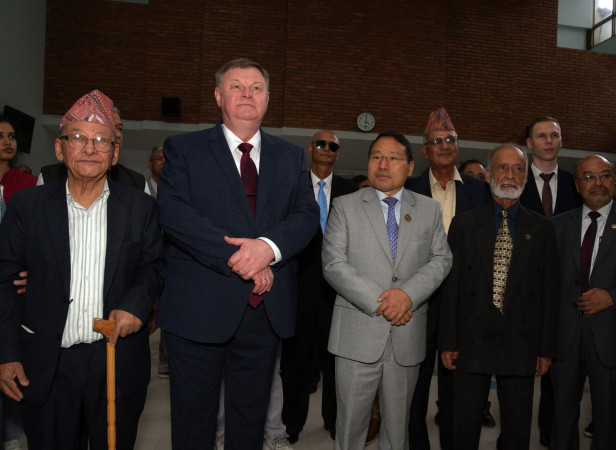
Kathmandu, July 20: The Russian House in Kathmandu on Monday hosted a gala evening to commemorate the 70th anniversary of the establishment of diplomatic relations between Russia and Nepal, celebrating seven decades of friendship, cooperation, and people-to-people ties.
The programme began with the inauguration of the historical photo exhibition titled "Russia–Nepal: 70 Years of Friendship and Cooperation", marked by the traditional lighting of the Panas. The event brought together diplomats, parliamentarians, former ministers, leaders of Nepal–Russia friendship organizations, academics, and cultural figures.
Among the distinguished guests were Hon. Barsaman Pun, Member of Parliament, Coordinator of the Nepal–Russia Parliamentary Friendship Group and former Minister; Ambassador of the Russian Federation to Nepal Aleksei Vladimirovich Surovtsev; Director of the Russian House in Kathmandu Anastasia Khokhlova; and representatives of various Nepal–Russia friendship organizations.
Following the national anthems of Nepal and Russia, congratulatory messages from Nepal's Minister for Foreign Affairs Shishir Khanal and Russian Foreign Minister Sergey Lavrov were read before the audience.
Addressing the gathering, Ambassador Surovtsev reflected on the enduring partnership between the two countries and recalled the meeting between the leaders of Nepal and Russia on the sidelines of the Shanghai Cooperation Organisation (SCO) Summit in Tianjin in September 2025. He expressed appreciation for the numerous Nepali and Russian organizations that have strengthened bilateral cooperation over the decades.
Recalling the long-standing goodwill between the peoples of the two countries, Ambassador Surovtsev said the warmth shown by the Nepali people towards Russia continues to reflect the legacy of Soviet-era cooperation. He noted that the decades-old friendship provides a strong foundation for expanding modern cooperation in various sectors.
Speaking on the occasion, Russian House Director Anastasia Khokhlova highlighted the significant contribution of thousands of Nepali graduates from Soviet and Russian universities in fostering bilateral relations. She said the Russian House has served as the flagship of Russia's humanitarian and cultural engagement in Nepal for more than four decades.
She also emphasized the growing academic, educational, and cultural cooperation between the two countries, expressing confidence that the long-standing partnership would further expand in the areas of trade, higher education, youth exchange, and cultural collaboration.
During the programme, the Russian House presented a Letter of Appreciation to Swaraj Shakya, Secretary General of the Nepal–Russia Friendship and Cultural Association, in recognition of his contribution to strengthening bilateral relations. The Association was also honoured with a "Token of Love" for its continued efforts to promote friendship between the two nations.
Representatives of several Nepal–Russia organizations, including the Nepal Russia-Science Society, Mitra Kunj Alumni Association, Friends of RUDN Society, Nepal–Russia Literary Association, Nepal–Russia Chamber of Commerce, and Shailee Theatre, also shared their reflections on the long-standing partnership.
The celebration concluded with vibrant cultural performances featuring traditional Nepali dances, the classical ballet The Dying Swan performed by Yana Yeliseyeva, a musical performance by Juju Kaji Ranjit, and the popular Russian song "Nadezhda" (Hope) performed by Vera Yurchenko, symbolizing the enduring friendship between the people of Nepal and Russia.
The evening ended with a reception and informal interaction among guests, reaffirming the shared commitment of both countries to further strengthening diplomatic, cultural, educational, and people-to-people relations in the years ahead.